

A Kashmiri family preserves a legacy rooted in a 190-year-old ritual at an ancestral village.
On a misty summer morning in Srinagar, an old artist leans on his cane outside a corner shop, speaking in metaphors and proverbs as if weighing the city’s shifting ground.
His eyes follow the first stirrings of Downtown’s narrow lanes. Beside him, the grocer listens. They trade the line they’ve shared for years: “Things aren’t like they used to be.”
The city wakes. Shutters open and people step out, still rubbing sleep from their eyes, buying bread for breakfast. Smoke from firewood rises, mixing with the misty rain spray typical of a Kashmir morning, carrying the smell of fresh loaves from nearby ovens.
A boy rides his bicycle through rain puddles, dodging carts and stray dogs. The morning moves slowly, keeping its old rhythm.
The calm is interrupted as a black luxury sedan with Delhi plates moves through the lane and stops. A man steps out gracefully, dressed in rich overalls, holding a classy umbrella.
The artisan doesn’t move. A half-smile plays on his lips, classic Kashmiri humour and linguistics betraying the oral history that all of Kashmir carries proudly. “Look at him,” he says. “Zann chu BalKak Dhar.”
The grocer laughs. A few passersby smirk. The name brings back memories.
BalKak Dhar was no joke. A rich and respected Kashmiri from the Dogra days, who had say and sway in a world now long gone.
Even today, wealth and status are synonymous with that name; some people still joke, ‘Who do you think you are, BalKak Dhar?’, a sarcastic remark, even though the legendary Dhar himself never displayed his riches. He wielded quiet power and lived a simple and austere life.
The legend has faded with time; the man is now in the memory of a few old folks.
And yet, a mere thirty kilometres away, in the Pulwama village of Rohmoo, his descendants quietly carry a tradition that goes back to 1836 when Ganesh Pandit Dhar, the great-great-grandfather of Balkak Dhar, built a temple in the village and started a tradition that continues to this day.
Aditi Dhar, Balkak’s great-granddaughter, stands near the rusting iron gate of the family estate. The wheels crunch softly over gravel. Her boots, caked with the valley soil, leave faint prints behind. It’s a hot summer in the valley, and the heat hangs heavy in the air, sharp and dry. Walnuts are ripening. Their faint scent drifts through the air.
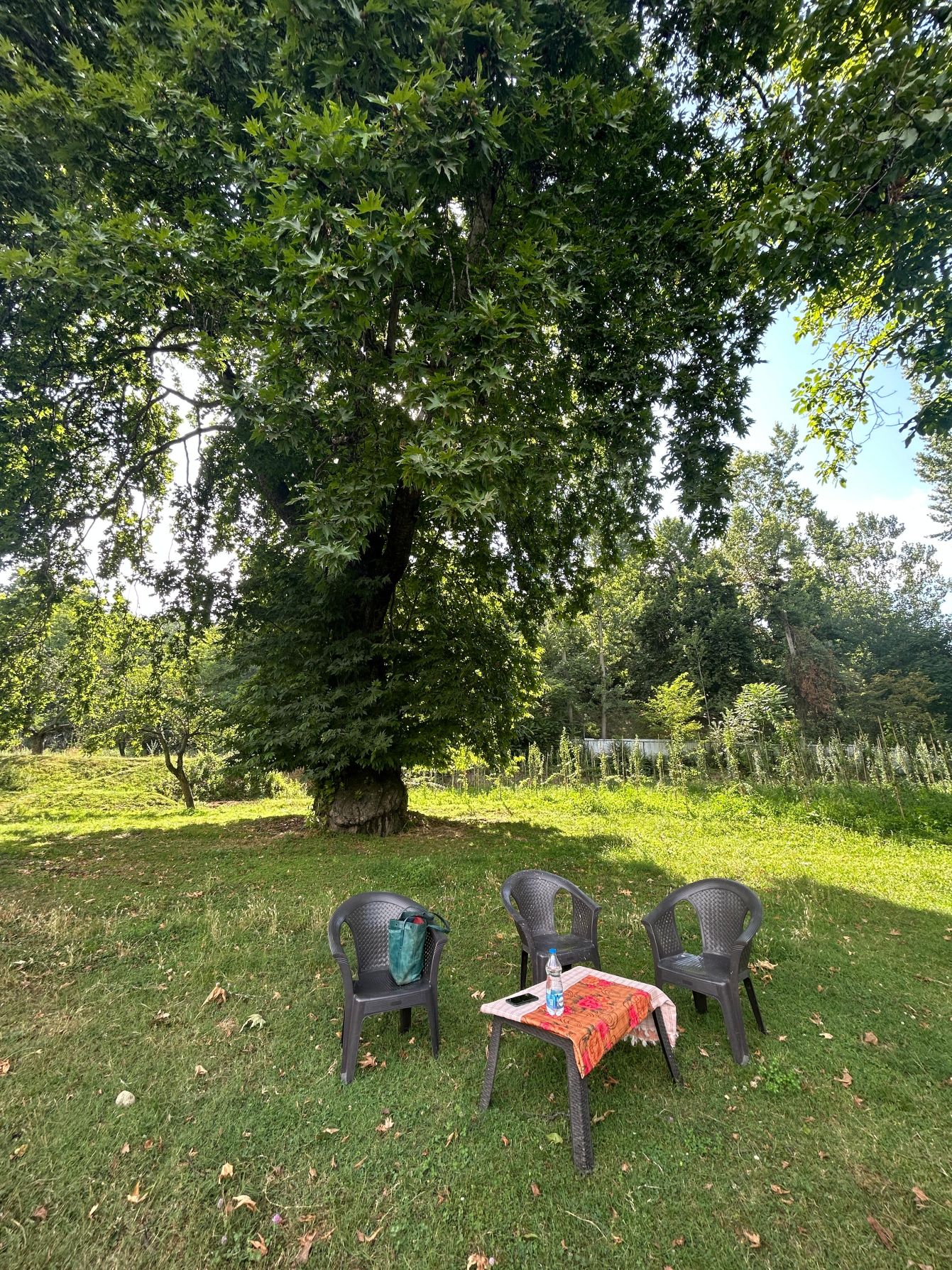
Aditi pauses near the old chinar.
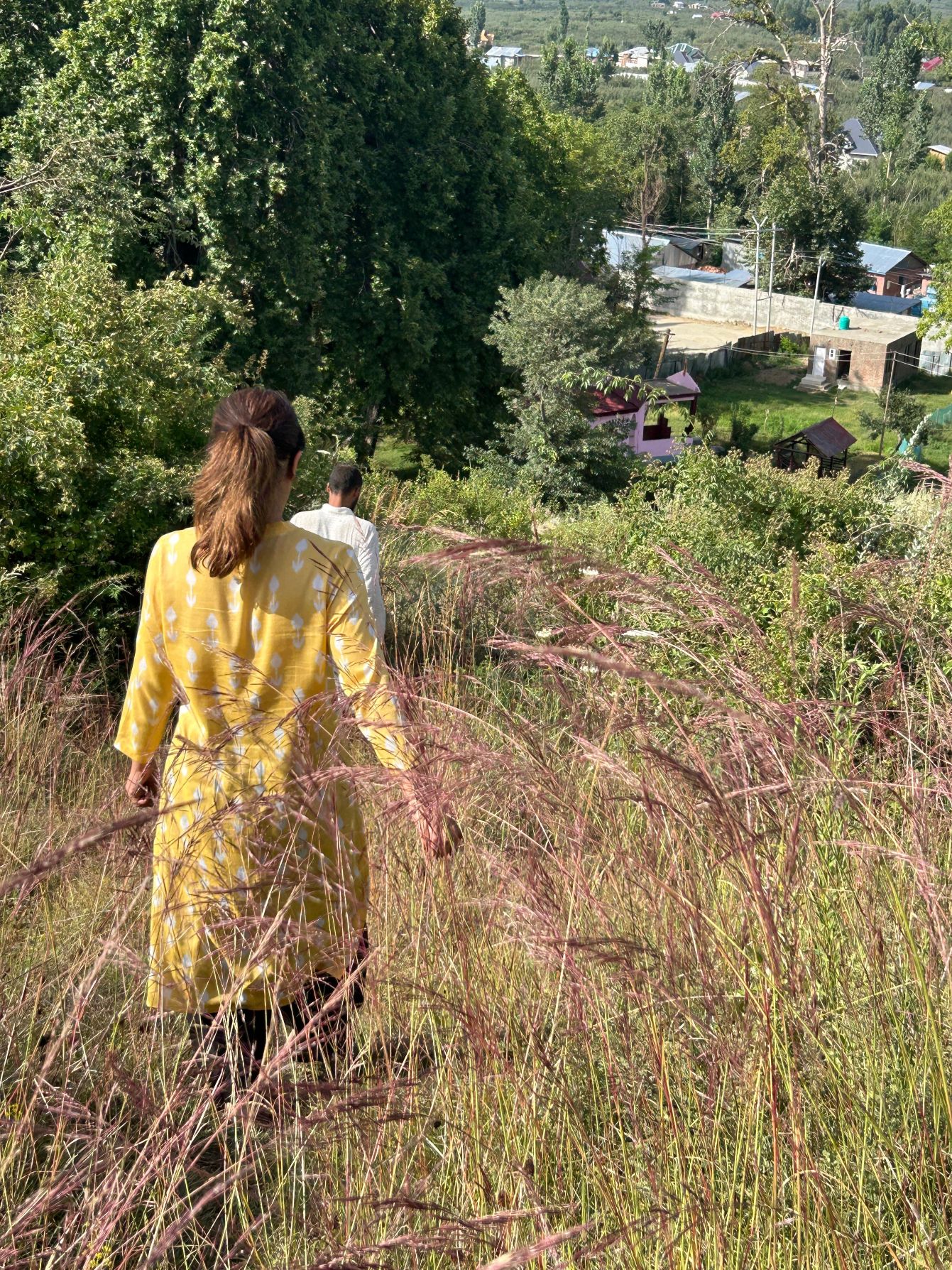
The tree towers in the centre of the yard as a living monument. Its bark and leaves cast copper light over the lawn.
Her father said, “That’s where the bull came to rest carrying a shiv ling, which Ganesh Pandit Dhar housed in the temple in 1836. It’s been resting there ever since.”
Aditi is a designer. She teaches form and function at the National Institute of Design. In Delhi, her life is crisp-lined, ruled by deadlines and pixel-perfect projects. In Kashmir, it unravels. Time slows.
She keeps returning to this spot, cared for by her ancestors. Unlike the majority of Kashmiri Pandits, her family stayed in Kashmir during its turbulence.
Although Balkak’s descendants have spread out over the globe, the family stays deeply connected to Kashmir. The temple and its orchard, famously called “Bal Kak Dhar’un Baagh,” root the Dhar family to Kashmir.
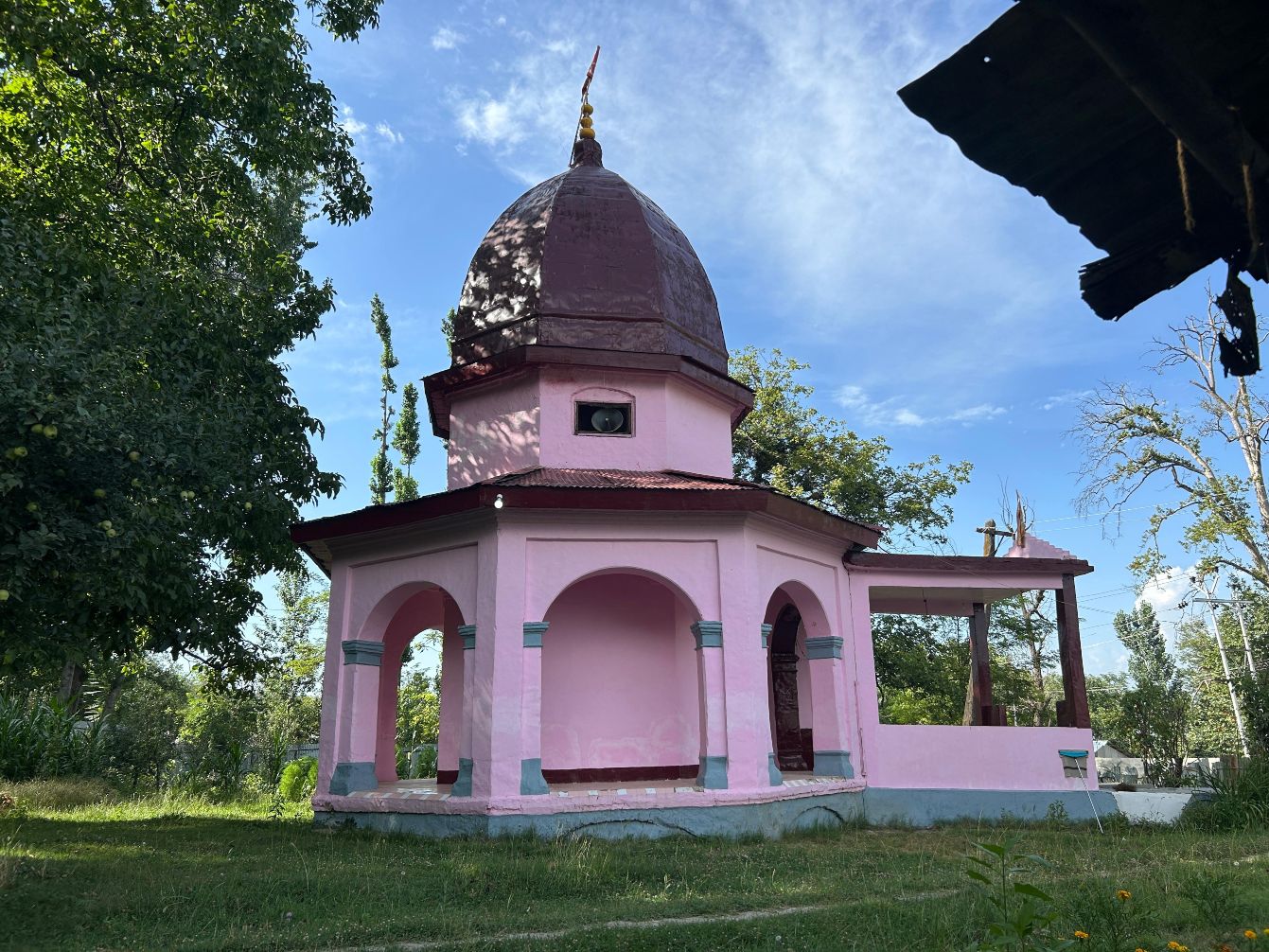
The old Rohmoo orchard and the sanctum are a page of living history. The temple still stands proud with its sloping roof, wide verandah, and a chinar-root cellar where elders stacked salt and pickles for the winter.
The lawn is alive alongside high-density apple trees. Moss slicks the stone path that winds toward the orchard.
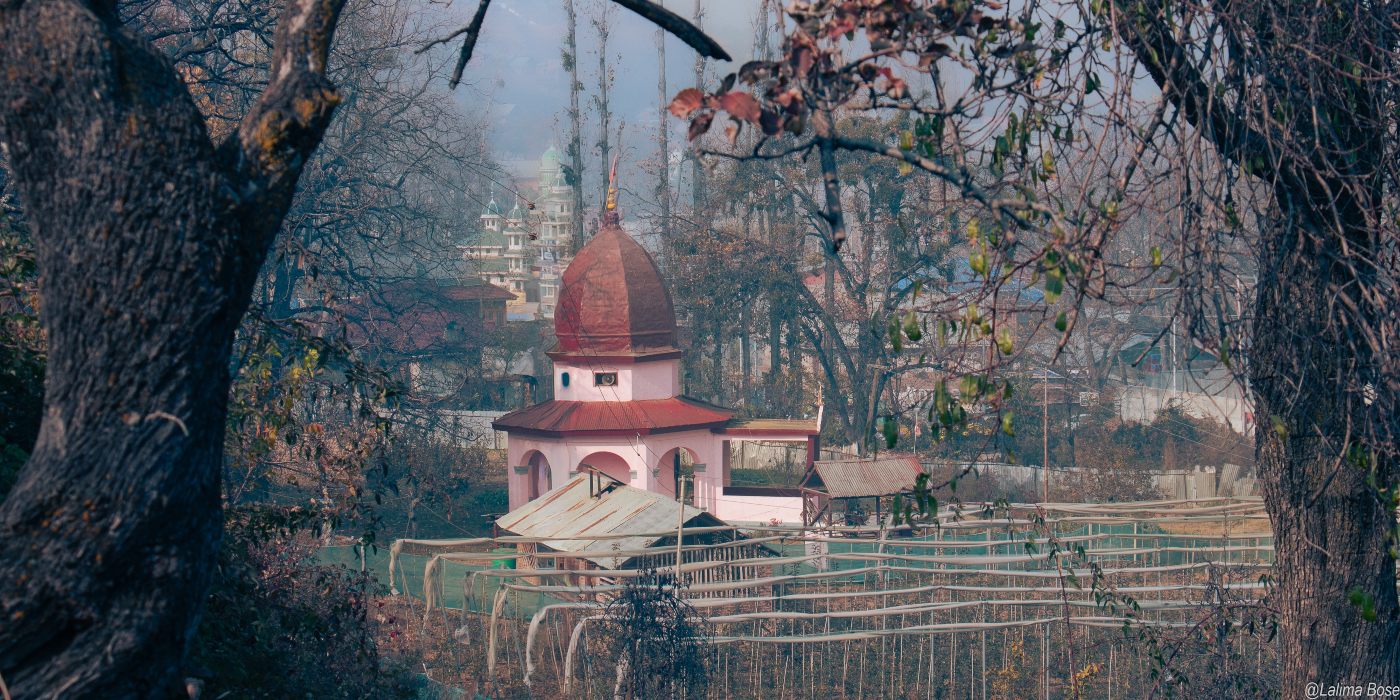
At the edge of the orchard is the Dhar family heirloom: A Shiv Temple.
Built on a low platform, it sits half-hidden behind willow branches. The air smells faintly of incense and damp earth.
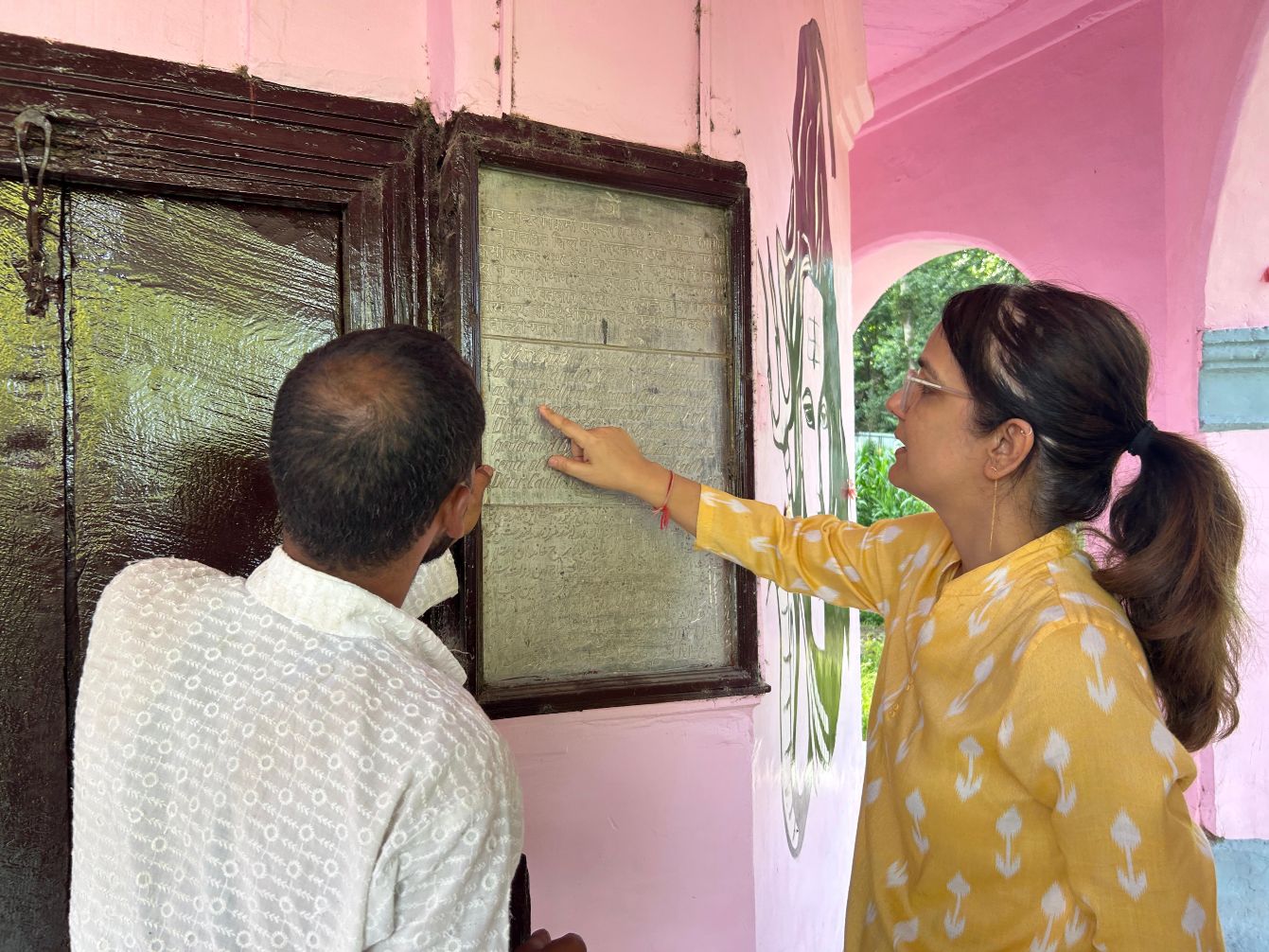
Persian inscriptions curl along the entrance arch. Aditi has traced them with her fingers many times, trying to read the poetry etched by someone long forgotten. A plaque marks the centennial ceremony of the temple conducted in 1936 by Balkak Dhar and his sons.
Inside the sanctum, portraits and prophets of many faiths look down from the walls: Jesus beside Hanuman, Guru Nanak beside an image of Madinah’s mosque.
On the floor, a soldier’s trunk from Haryana sits, like a footnote in this melting pot of faith.
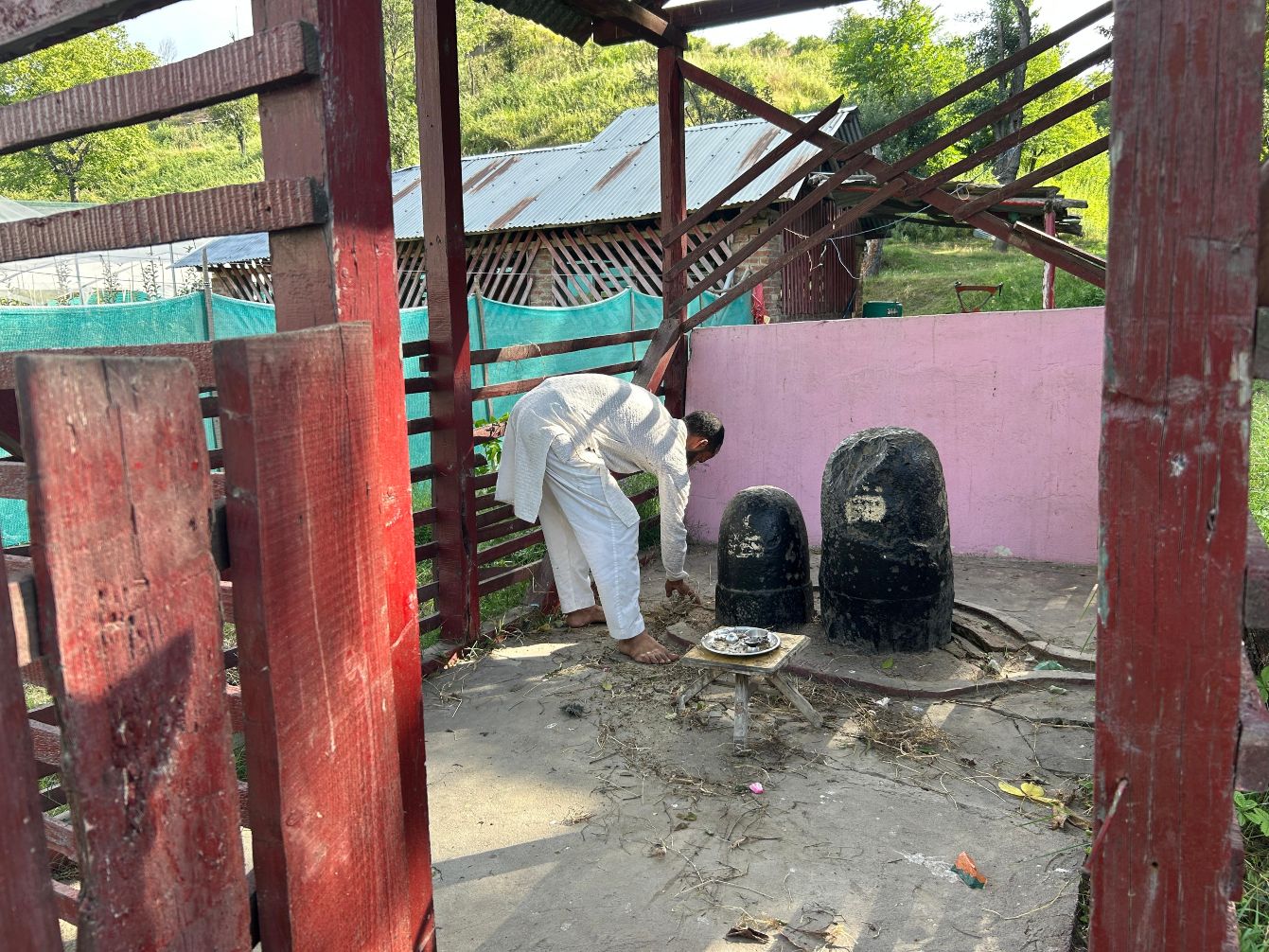
In the middle of the temple, there’s a gigantic black stone, said to have been found at the bottom of the Jhelum by an ancestor after he dreamed that Shiva asked to be moved to a new spot.
That dream gave rise to a tradition: the annual havan on a specific full moon of the year: Jesht Purnamashi.
In the old days, the family used to celebrate the occasion with music, lamps, and open doors. Then came the years of unrest, when the ritual was not on display, but still conducted annually without fanfare.
The famed ancestral home of Balkak Dhar in Srinagar’s Safa Kadal became the “Dhar School” after his death, but the family has always maintained a proper home in Srinagar, even during the depths of the mid-90s. Someone from the family always ensured that the annual havan took place and the lamps in the temple were lit.
Now, in addition to the family, others from surrounding villages come to celebrate the tradition with the Dhar family in Rohmoo, carrying the echoes of past glory entrenched in the Kashmiri psyche as an integral part of its culture.
Last spring, the temple flickered with light and liveliness. Rose petals circled the brass diyas. Incantations hung in the rafters. And then, through the open gate, a middle-aged woman walked in.
She was barefoot, silver hair pinned tight. Two children held the edge of her shawl. She called herself a Pandit teacher.
“I used to play under this chinar tree,” she said, placing a hand on the chinar like greeting an old friend.
She sat cross-legged in the sanctum and sang. She said she had followed a dream. No one asked for more.
That’s how it is in Kashmir. Some arrivals don’t need explaining. They feel like connections.
The Dhar family’s preservation of the family heirloom is more than sentimental. It’s become a pathway of remembrance and honouring the ancestors who have come to this spot on a specific day for the past 190 years
Now scattered across the world, the Dhars come home to Kashmir regularly. They bring tools and talent. One uncle is an author and a pioneer in Artificial Intelligence. An aunt records oral histories.
Aditi now leads the expansion of the orchard. Her drawings map landscapes. The soil, she says, knows more than we remember.
The Dhars have converted parts of the orchard into a high-density apple project. The saplings stretch in tight rows, hopeful and precise. Spring is magical, with a thousand trees flowering in unison
Aditi says she finds meaning in the small ceremonies and the rhythmic chants of her ancestors. “This house of faith is not a museum,” she says. “It’s still breathing and alive.”
The Qazi family in Rohmoo have been caretakers of the Dhar estate for decades. They trim trees, clear snow, and help light lamps in the temple. The new generation continues the practice. The Dhar family treats them like kin.
“When we care for the land,” he says, “we remember who we are.”
Recently, Aditi’s friends visited the estate. They sat under the chinar and left with sketchbooks full of ideas. “They saw beauty here,” Aditi says. “In a future-forward way.”
With a gentle smile and a sparkle in her eyes, Aditi heads back to the city. But she and the rest of the Dhars will return and continue to celebrate the special present their ancestor left them 190 years ago: an enduring tradition. How many families are fortunate enough to share it with future generations?
To be continued…